

Red Vine Leaf Extract Market Outlook 2026–2036: Global Market to Reach USD 11.27 Billion by 2036 at 3.9% CAGR | FMI
Red Vine Leaf Extract Industry Size
Red vine leaf extract market grows steadily as clinical validation and clean-label demand drive adoption in supplements and pharmaceutical applications.
NEWARK, DE, UNITED STATES, March 17, 2026 /EINPresswire.com/ -- According to analysis by Future Market Insights (FMI), the global red vine leaf extract market is entering a phase of clinically anchored expansion as pharmaceutical and nutraceutical companies increasingly prioritize evidence-backed botanical ingredients for circulatory health and venous insufficiency management.
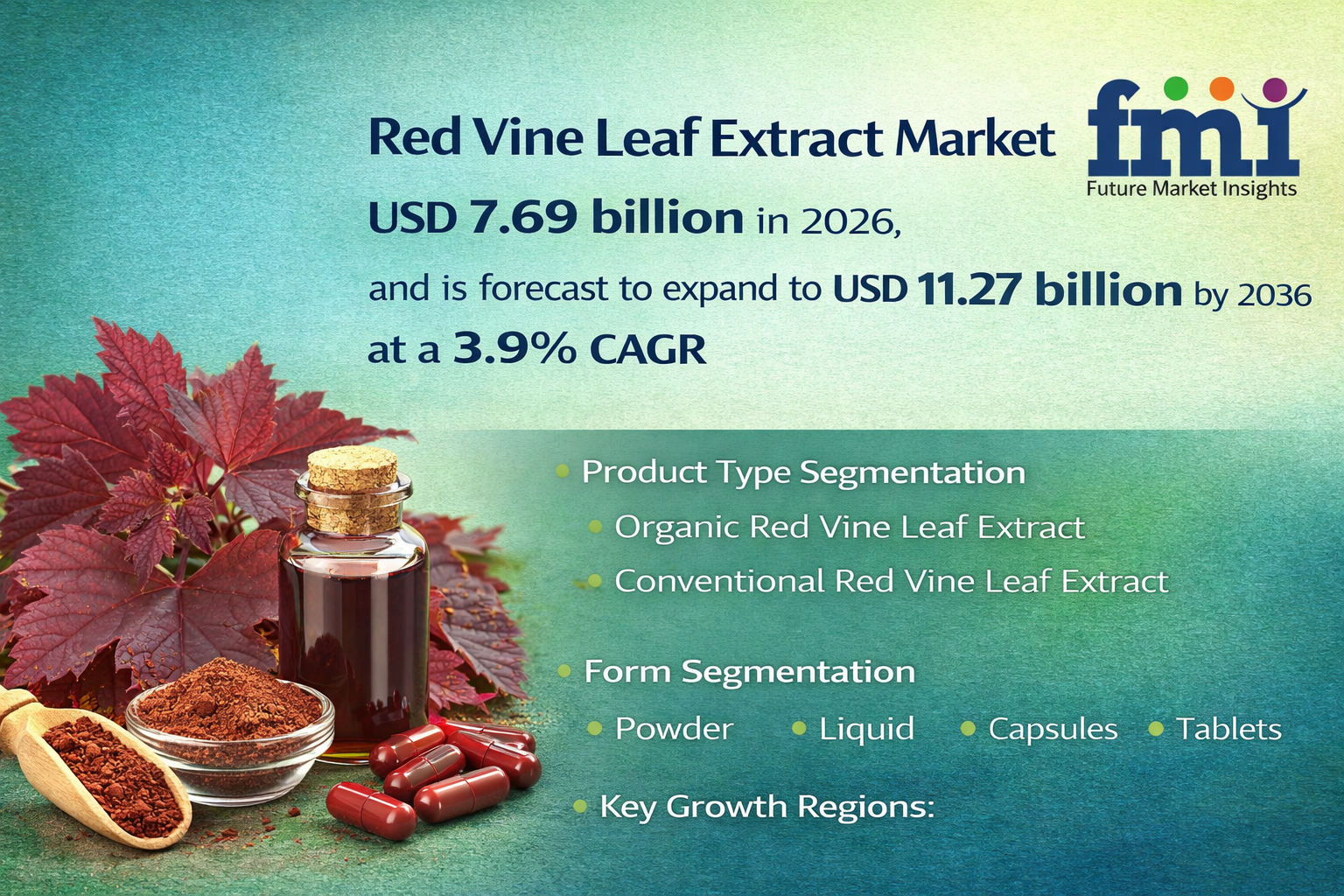
The market was valued at USD 7.40 billion in 2025 and is projected to reach USD 7.69 billion in 2026. Over the forecast period, demand is expected to grow steadily at a CAGR of 3.9%, ultimately reaching USD 11.27 billion by 2036.
This growth trajectory reflects a structural shift in botanical ingredient adoption—moving from traditional herbal use toward clinically validated, pharmacopoeia-recognized plant extracts. Red vine leaf extract, supported by flavonoid and polyphenol efficacy data, is emerging as a preferred ingredient across regulated pharmaceutical and high-value supplement formulations.
To Explore Detailed Market Data, Segment-Wise Forecasts, and Competitive Insights, Request Sample Report! https://www.futuremarketinsights.com/reports/sample/rep-gb-23158
Red Vine Leaf Extract Market Snapshot
• Market Value (2025): USD 7.40 Billion
• Forecast Value (2036): USD 11.27 Billion
• Forecast CAGR (2026–2036): 3.9%
• Leading Product Type: Organic (56.0%)
• Top Application Segment: Dietary Supplements (36.0%)
• Leading Form: Powder (42.0%)
• Fastest Growing Markets: China & India
Clinical Validation and Pharmacopoeia Recognition Driving Market Credibility
A primary growth driver for the red vine leaf extract market is the strong clinical validation supporting its efficacy in managing chronic venous insufficiency and improving circulatory health.
Unlike many botanical ingredients, red vine leaf extract benefits from inclusion in European pharmacopoeia monographs, providing a standardized regulatory framework for quality, composition, and therapeutic claims.
FMI analysts highlight that this regulatory backing creates a significant competitive advantage, positioning red vine leaf extract as one of the few botanicals with multi-jurisdictional acceptance for medicinal and supplement applications.
As a result, pharmaceutical companies and healthcare practitioners demonstrate higher confidence in prescribing and recommending products containing this extract.
Organic Certification Becomes a Strategic Procurement Priority
Procurement strategies are increasingly shaped by demand for clean-label, pesticide-free botanical ingredients.
Organic red vine leaf extract is projected to account for approximately 56.0% of the market share in 2026, reflecting strong preference among supplement and pharmaceutical manufacturers for certified, traceable raw materials.
Key procurement considerations include:
• Compliance with organic certification standards
• Alignment with clean-label positioning
• Consumer trust in pesticide-free formulations
• Premium pricing justification through quality assurance
This trend is particularly prominent in Europe and North America, where regulatory scrutiny and consumer awareness are highest.
Powder Format Dominates Due to Formulation Flexibility
By form, powder-based red vine leaf extract is expected to account for 42.0% of the market in 2026.
Powder formats are widely preferred due to their versatility in formulation, enabling seamless integration into capsules, tablets, and functional beverages without requiring significant process modifications.
Additional advantages include:
• Precise dosage control across product formats
• Extended shelf stability
• Compatibility with both solid and liquid formulations
• Cost-efficient transportation and storage
These attributes make powder the default format for manufacturers seeking scalable and flexible production systems.
Dietary Supplements Anchor Demand Amid Rising Self-Medication Trends
The dietary supplements segment is projected to hold 36.0% of total demand in 2026, driven by increasing consumer awareness of circulatory health and preventive care.
An aging global population, particularly in Europe, Japan, and North America, is fueling demand for natural solutions addressing venous disorders, leg fatigue, and vascular health.
Manufacturers in this segment prioritize ingredients that:
• Offer clinically supported health benefits
• Enable clear product positioning in pharmacy channels
• Align with preventive healthcare trends
• Deliver consistent efficacy across batches
Pharmacy-led recommendations and e-commerce expansion are further accelerating supplement adoption.
Asia-Pacific and Europe Lead Regional Growth Momentum
Regionally, the red vine leaf extract market demonstrates balanced growth across developed and emerging economies.
China leads with a 5.3% CAGR, supported by integration into traditional medicine and expanding nutraceutical demand.
India follows at 4.9%, driven by rising adoption in herbal and Ayurvedic formulations.
Germany (4.5%) and France (4.1%) benefit from strong pharmaceutical botanical traditions and regulatory clarity.
United Kingdom and United States markets show steady growth, supported by dietary supplement demand and increasing awareness.
Europe remains a critical hub due to its established pharmacopoeia standards and raw material sourcing from vineyard regions.
Technological Advancements Enhancing Extract Performance
Innovation in extraction and delivery technologies is reshaping the competitive landscape.
Advanced techniques such as:
• Supercritical CO₂ extraction
• High-performance liquid chromatography (HPLC)
• Nanotechnology-based delivery systems
are improving the concentration, bioavailability, and consistency of active compounds.
These advancements enable manufacturers to develop high-efficacy formulations with enhanced absorption and targeted therapeutic outcomes, opening opportunities in pharmaceutical and medical nutrition segments.
Competitive Landscape: Focus on Standardization and Clinical Differentiation
Leading companies operating in the global red vine leaf extract market are focusing on clinical validation, standardized production, and supply chain transparency.
Key players include:
• INDENA S.p.A
• Euromed S.A
• Naturex (Givaudan)
• Martin Bauer Group
• Bio-Botanica, Inc.
These companies leverage pharmaceutical-grade manufacturing, global sourcing networks, and R&D capabilities to maintain competitive positioning in a quality-sensitive market.
Market Outlook: Evidence-Based Botanicals Gain Strategic Importance
The long-term outlook for the red vine leaf extract market remains stable and resilient, supported by its strong clinical foundation and regulatory acceptance.
As demand for plant-based therapeutics, preventive healthcare, and clean-label ingredients continues to grow, red vine leaf extract is expected to maintain its position as a high-value botanical ingredient.
FMI analysts conclude that while growth remains moderate due to the maturity of venous health applications, the market offers a defensible revenue base driven by clinical credibility, pharmacist endorsement, and regulatory alignment.
Explore FMI’s Extensive Coverage in the Food and beverage Domain:
Flavor and Flavor Enhancers Market: https://www.futuremarketinsights.com/reports/flavour-and-flavour-enhancers-market
Acai Berry Market: https://www.futuremarketinsights.com/reports/acai-berry-market
Ursolic Acid Market: https://www.futuremarketinsights.com/reports/ursolic-acid-market
Artificial Sweetener Market: https://www.futuremarketinsights.com/reports/global-artificial-sweeteners-market
Sudip Saha
Future Market Insights Inc.
+ +1 347-918-3531
email us here
Legal Disclaimer:
EIN Presswire provides this news content "as is" without warranty of any kind. We do not accept any responsibility or liability for the accuracy, content, images, videos, licenses, completeness, legality, or reliability of the information contained in this article. If you have any complaints or copyright issues related to this article, kindly contact the author above.
