

UK Coffee Extracts Market Grow at USD 243.1 Million by 2036, Driven by Beverage and Food Industry Demand
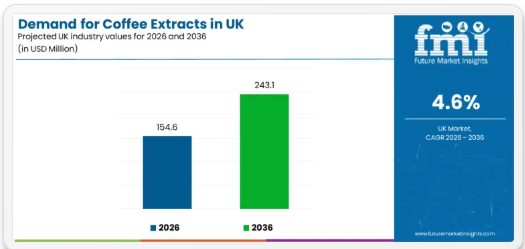
UK demand for coffee extracts to expand steadily over the next decade as beverage operators and food manufacturers prioritise consistency and efficiency.
NEWARK, DE, UNITED STATES, January 21, 2026 /EINPresswire.com/ -- The UK coffee extracts market is projected to record steady expansion over the next decade, increasing from USD 154.6 million in 2026 to USD 243.1 million by 2036, at a compound annual growth rate (CAGR) of 4.6 %. The outlook reflects sustained demand from the beverage sector, food manufacturing, and value-added coffee applications where consistency, scalability, and operational efficiency are critical.
Who, What, When, Where, Why, and How
Who: Beverage operators, food manufacturers, ingredient suppliers, and product developers across the UK
What: Rising demand for coffee extracts used in beverages, baked goods, desserts, and packaged food products
When: Forecast period from 2026 to 2036
Where: United Kingdom, with strongest growth concentration in England
Why: Increasing need for flavour consistency, faster preparation, and standardised production
How: Adoption of liquid and roasted coffee extract formats across high-volume commercial applications
Market Context: Coffee Culture Meets Industrial Efficiency
The UK’s established coffee culture continues to evolve, with consumers expecting consistent flavour quality across cafés, foodservice outlets, and packaged products. Coffee extracts play a critical role in meeting these expectations, offering manufacturers and operators a reliable alternative to traditional brewing while supporting large-scale production requirements.
Extract-based formulations reduce preparation variability, improve shelf stability, and allow for easier integration into ready-to-drink beverages, baked goods, and desserts. As menu diversification accelerates, particularly in cold and specialty beverages, extracts provide flexibility without compromising taste integrity.
Beverage Industry Leads End-Use Demand
The beverage segment represents the largest share of demand, accounting for 31.6 % of total market consumption. Coffee extracts are widely used in cafés, quick-service restaurants, and institutional settings where speed, repeatability, and flavour uniformity are operational priorities.
Beyond beverages, extracts are increasingly incorporated into confectionery, bakery products, ice creams, and flavouring systems, where traditional ground coffee can introduce sediment, bitterness, or formulation challenges.
Product Segmentation Highlights
Conventional Extracts Dominate Market Share
Conventional coffee extracts hold 76.5 % of the market, reflecting broad availability, cost efficiency, and compatibility with mainstream product formulations. While organic variants are gaining attention, adoption remains limited by pricing and supply considerations.
Liquid Concentrates Remain Preferred Format
Liquid coffee extracts account for 40.6 % of demand, driven by ease of dosing, rapid solubility, and consistent dispersion across beverage and food matrices. Their adaptability makes them particularly suitable for high-throughput operations.
Roasted Extracts Align with Consumer Taste Preferences
Roasted coffee extracts represent 67.3 % of market share, mirroring consumer preference for familiar, robust coffee flavour profiles. These extracts are commonly used to replicate freshly brewed taste characteristics in commercial applications.
Growth Drivers and Market Challenges
Key growth drivers include the expansion of ready-to-drink coffee offerings, increasing automation in food and beverage production, and the need for scalable flavour solutions. Extracts also support faster product innovation cycles, enabling seasonal and limited-edition launches with minimal process disruption.
However, the market faces challenges such as sensitivity to oxidation, heat exposure during processing, and fluctuations in raw coffee prices. Effective formulation, storage, and handling practices remain essential to maintaining flavour quality and cost stability.
Competitive Landscape
The UK coffee extracts market features a mix of established ingredient suppliers and specialised flavour producers. Competitive differentiation is driven by formulation expertise, consistency performance, technical support, and the ability to customise extracts for specific applications across beverage and food categories.
Market Outlook
With the market projected to reach USD 243.1 million by 2036, coffee extracts are expected to remain a foundational ingredient in the UK’s evolving beverage and food industries. Stakeholders across manufacturing, foodservice, and retail supply chains are likely to prioritise extract-based solutions as they seek to balance quality, efficiency, and scalability in a competitive operating environment.
Request for Sample Report | Customize Report |purchase Full Report – https://www.futuremarketinsights.com/reports/sample/rep-gb-31650
Explore More Related Studies Published by FMI Research:
DiMethyl Sulfoxide (DMSO) Market https://www.futuremarketinsights.com/reports/dimethyl-sulfoxide-dmso-market
Dimethylformamide (DMF) Market https://www.futuremarketinsights.com/reports/dimethylformamide-market
Dimethyl Disulphide (DMDS) Market https://www.futuremarketinsights.com/reports/dimethyl-disulphide-dmds-market
About Future Market Insights (FMI)
Future Market Insights, Inc. (FMI) is an ESOMAR-certified, ISO 9001:2015 market research and consulting organization, trusted by Fortune 500 clients and global enterprises. With operations in the U.S., UK, India, and Dubai, FMI provides data-backed insights and strategic intelligence across 30+ industries and 1200 markets worldwide.
Why Choose FMI: https://www.futuremarketinsights.com/why-fmi
Sudip Saha
Future Market Insights Inc.
+1 347-918-3531
rahul.singh@futuremarketinsights.com
Legal Disclaimer:
EIN Presswire provides this news content "as is" without warranty of any kind. We do not accept any responsibility or liability for the accuracy, content, images, videos, licenses, completeness, legality, or reliability of the information contained in this article. If you have any complaints or copyright issues related to this article, kindly contact the author above.
