

Trends in North America Post-Consumer Recycled Plastics Food Packaging Market 2035
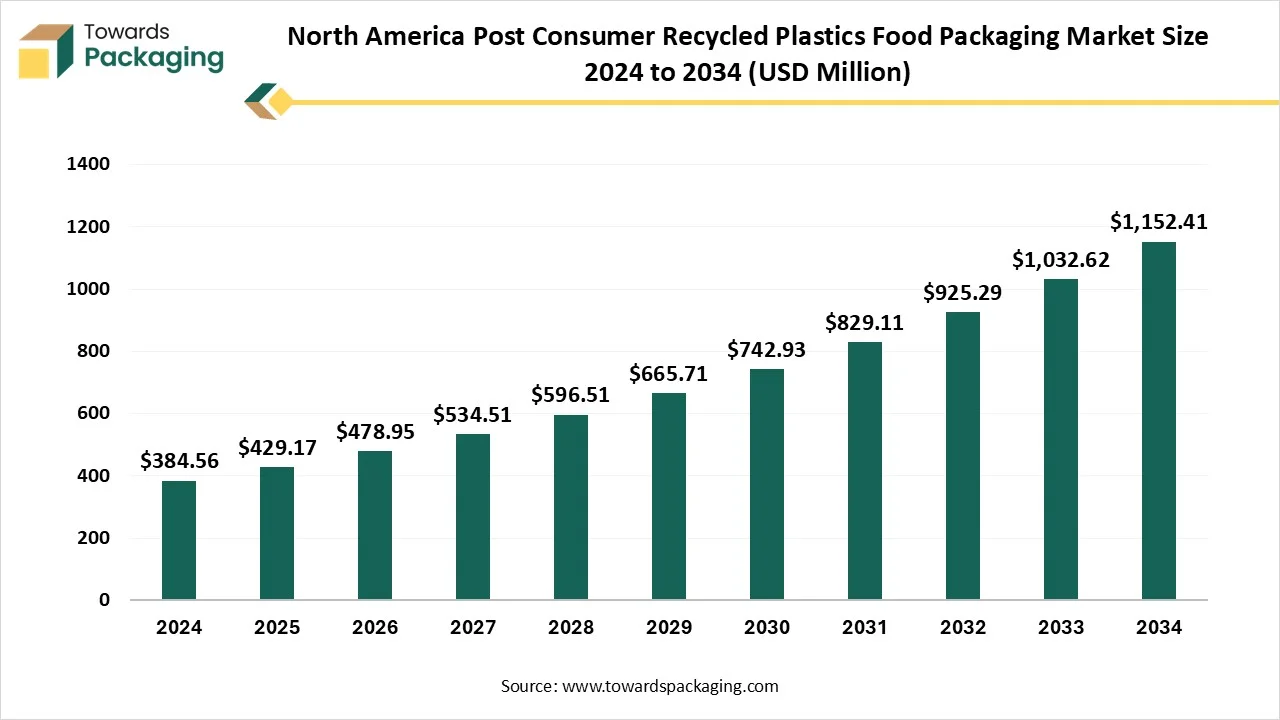
According to projections from Towards Packaging, the global North America post-consumer recycled plastics food packaging market is set to increase from USD 478.95 billion in 2026 to nearly USD 1152.41 billion by 2034, reflecting a CAGR of 11.60% during 2025 to 2034.
Ottawa, Dec. 04, 2025 (GLOBE NEWSWIRE) -- The global North America post-consumer recycled plastics food packaging market was assessed at USD 429.17 billion in 2025, with projections indicating an increase to USD 1152.41 billion by 2034, based on insights from Towards Packaging, a sister firm of Precedence Research. The market is significant as it supports the circular economy, meets increasing consumer need for sustainable products, and is driven by government regulations encouraging recycling and recycled content.
Request Research Report Built Around Your Goals: sales@towardspackaging.com
What is Meant by Post-Consumer Recycled Plastics Food Packaging in North America?
North America's post-consumer recycled (PCR) plastics food packaging mainly refers to plastic food containers as well as wrappers made from plastic waste, which has been used by users and then reprocessed into new packaging. This procedure diverts plastic from landfills, decreases the demand for new, fossil-fuel-based plastics, and thus, is increasingly being utilized to meet sustainability goals. Safety and purity regulations are vital for its use in food-contact applications.
The recycling process must manage the purity of the plastic to protect it from contaminants that could affect the food. Regulatory bodies such as the FDA evaluate proposed purposes of PCR in food packaging on a case-by-case basis.
Get All the Details in Our Solutions - Access Report Sample: https://www.towardspackaging.com/download-sample/5856
North America Government Initiatives for the Post-Consumer Recycled Plastics Food Packaging Industry:
- U.S. Food and Drug Administration (FDA) Guidance Letters The FDA provides guidance to manufacturers through individual "opinion letters" to help them determine if their specific plastic recycling processes produce material of suitable purity and safety for food-contact applications.
- California Recycled Content Mandate (AB 793) This state law requires post-consumer recycled content percentages in plastic beverage containers, mandating 25% PCR by 2025 and 50% by 2030, to create market demand for recycled material.
- Canada's Federal Plastics Registry The Canadian government is establishing a mandatory reporting registry for companies involved in the plastics value chain to collect data, improve transparency, and help harmonize extended producer responsibility (EPR) policies across the country.
- Canada's Single-Use Plastics Prohibition Regulations The federal government has banned several categories of single-use plastics, including certain types of food packaging, pushing the industry towards reusable or fully recyclable solutions.
- Extended Producer Responsibility (EPR) Policies (Various States/Provinces) Multiple U.S. states and Canadian provinces are shifting the financial and operational burden of managing packaging waste from municipalities to the producers, encouraging the use of more recyclable and recycled materials.
- Mexico's Alignment with the New Plastics Economy Global Commitment Mexico City and various industry members have signed on to the UN-backed Global Commitment, a voluntary initiative to accelerate the transition to a circular economy for plastics by eliminating problematic plastics and ensuring materials are circulated at their highest value.
What are the Latest Trends in the North America Post-Consumer Recycled Plastics Food Packaging Market?
-
Advancements in Both Mechanical and Chemical Recycling Technologies
Mechanical recycling is being improved to manufacture higher-quality, more consistent recycled plastics, while chemical recycling can now process mixed and contaminated plastics, which were previously challenging to recycle, creating a more comprehensive and even circular system. Newer technologies improve the quality and purity of recycled plastics, thus making them suitable for more demanding applications, which include food-grade packaging.
Chemical recycling processes can break down mixed and even contaminated plastic streams, which are not suitable for mechanical recycling, into their original monomers or a few valuable feedstocks. Customers are increasingly choosing goods with sustainable packaging, putting pressure on food firms to use recycled content.
What Potentiates the Growth of the North America Post-Consumer Recycled Plastics Food Packaging Market?
-
Consumer Demand for Sustainable Products
By driving brands to use more eco-friendly packaging to meet user preferences and, in many cases, comply with regulations. This need creates a market pull for PCR plastics, which assists in reducing waste and conserving resources, and is funded by technological advancements that enhance the quality of recycled materials.
Governments in North America are incorporating stricter policies to decrease plastic waste, like bans on single-use plastics and even regulations that demand a certain percentage of recycled content in packaging. This forces firms to adopt PCR solutions to remain compliant.
More Insights of Towards Packaging:
- Plastic Films and Sheets Market Trends, Disruptors & Competitive Strategy
- Flexible Polyurethane Foam Market Demand, Size, and Growth Rate Forecast 2034
- Polyethylene Mailers Market Sustainability Shift: Eco-Friendly Materials Leading the Way
- Disposable Food Containers Market Trends 2025-34: Smart Packaging, Biodegradable Materials & Regional Insights
- Disc Top Caps Market to Witness Robust Growth by 2034 | Personal Care & Pharma Packaging Demand Surges
- Pre-Conditioned Packaging Market Set to Surge Through 2034 | Cold Chain & E-Commerce Drive Growth
- Non-cushioned Mailers Market Demand Surges Across E-commerce and Logistics
- Molded Pulp Packaging Market Growth, Innovations, and Market Size Forecast 2034
- Dip Tube Market Performance, Trends and Strategic Recommendations
- Clear Plastic Sheets Market Outlook Scenario Planning & Strategic Insights
- Plastic Packaging for Food and Beverage Market Performance, Trends and Strategic Recommendations
- Pharmaceutical Tube Packaging Market Growth Fueled by AI, Personalized Medicine & Clean Label Trends
- Cold Form Blister Packaging Market Analysis, Demand, and Growth Rate Forecast 2034
- Automotive Plastic Compounding Market Size & Business Model Innovation
Country Analysis
U.S. Market Trends
The U.S. market for post-consumer recycled (PCR) plastics in food packaging is boosted by strong sustainability goals, consumer need for eco-friendly products, and enhanced recycling technology. Key trends include the rising use of PCR materials such as PET and HDPE in rigid and flexible packaging, the growth of recycling infrastructure, and even supportive government policies and regulations, mainly Extended Producer Responsibility (EPR). Policies are speeding up the shift towards sustainable packaging solutions and also increasing compliance expenses for non-compliant brands.
Canada Market Trends
Canada's post-consumer recycled (PCR) plastics for food packaging market is driven by increased consumer need for eco-friendly products, government sustainability mandates, and enhancing recycling infrastructure. Investments in the latest recycling technologies are making it more feasible for firms to use PCR plastics. This includes better sorting techniques as well as advancements in chemical recycling, which assist in processing complex materials such as non-bottle rigid plastics.
Segment Outlook
Material / Resin Type Insights
Why did the PET (Polyethylene Terephthalate) Segment Dominate the North America Post-Consumer Recycled Plastics Food Packaging Market in 2024?
It is highly recyclable, lightweight, and also cost-effective, with a solid recycling infrastructure for bottles and containers. Its excellent properties, like transparency and barrier protection, make it ideal for food and beverage packaging, while regulatory drive for recycled content and corporate sustainability goals, thus boost the need for PCR PET.
Why did the HDPE (High-Density Polyethylene) Segment Considered the Fastest Growing in the Market During the Forecast Period?
Due to its strength, durability, along chemical resistance, it is ideal for a broad range of food and beverage containers. Strict FDA and EPA regulations encourage the use of food-safe, recyclable, and sustainable materials. At the same time, heightened user awareness about plastic pollution is driving brands to use recycled content to meet the requirement for eco-friendly packaging. Innovations in thus, advanced high-density molding techniques as well as multi-layered HDPE structures are assisting to reduce expenses while improving performance and enabling the usage of higher percentages of PCR HDPE in food-grade applications.
Packaging / Product Type Insights
Why did the Bottles & Jars Segment Dominate the North America Post-Consumer Recycled Plastics Food Packaging Market in 2024?
This is due to its high need in the beverage and food industries, its role as a main source of rPET and also rHDPE materials for bottle-to-bottle recycling, and even strong regulatory support for using recycled content. The industry has a solid incentive for "bottle-to-bottle" recycling, which enables used plastic bottles to be thus, converted into high-quality materials for new bottles, directly funding a circular economy model and the usage of PCR materials such as rPET and rHDPE.
Regulations in North America are increasingly driving or mandating the usage of recycled content in products, mainly in food packaging, which further fuels the need for PCR plastics in the bottle and jar segments.
Why was the Pouches & Bags Segment Considered the Fastest-Growing in the Market During the Forecast Period?
Due to a combination of factors, which include increased consumer need for sustainable options, the versatility and also convenience of flexible packaging, and even advancements in recycling technology that enable for high-quality PCR plastics to be utilized in food-grade applications. Brands are also increasingly utilizing mono-material solutions, like recyclable PE and PP pouches, to meet regulatory demands and also consumer expectations for more environmentally friendly packaging. Flexible packaging, such as pouches, provides convenience and portability, and thus, can be designed to offer strong protection against moisture, oxygen, and also contaminants, extending shelf life.
Raw Material / Waste Stream Source Insights
Why did the Bottles (rigid containers) Segment dominate the North America Post-Consumer Recycled Plastics Food Packaging Market in 2024?
This is due to its widespread usage in the large and rising beverage and food industries, where it offers essential durability, protection, and also shelf-life. Bottles and jars provide excellent protection against impacts, and environmental factors, and even contamination, which is crucial for food safety, along with extending product shelf life. The shift from glass to plastic bottles for weight as well as breakage concerns further supports this advantage.
End-Use / Application Insights
Why did the Food Segment Dominate the North America Post-Consumer Recycled Plastics Food Packaging Market in 2024?
This is due to a combination of high consumer need for sustainable products, stringent government regulations encouraging waste reduction, and even the essential nature of packaging for food safety and preservation. Food packaging is vital for product safety, shelf life, and also freshness, making the adoption of sustainable options in this sector mainly important and challenging. Improvements in recycling technologies, which include chemical recycling, are making PCR plastics higher quality and even more suitable for food-contact applications.
Why was the Beverage Segment Considered the Fastest Growing in the Market During the Forecast Period?
Due to the high availability of recycled plastic bottles, strong regulatory and user pressure for sustainability, as well as a well-established recycling infrastructure for bottles. Firms are increasingly using PCR plastics such as rPET for beverage bottles to meet environmental goals and the need from consumers for eco-friendly packaging. Policies, like those in California and Oregon demanding minimum recycled content in beverage containers, as well as national initiatives such as the U.S. Plastics Pact, are mandating and provoking the usage of recycled plastics, further driving market expansion.
Elevate your packaging strategy with Towards Packaging. Enhance efficiency and achieve superior results - schedule a call today: https://www.towardspackaging.com/schedule-meeting
Recent Breakthroughs in the Global North America Post-Consumer Recycled Plastics Food Packaging Industry
- In April 2025, Novolex concluded its acquisition of Pactiv Evergreen Inc. (trade value of around USD 6.7 billion), by combining their production and even recycling base in North America and Europe. This merger raises the ability to recycle-rich packaging and enhances the resilience of supply chains of PCR plastics thus, in the packaging industry.
Top Companies in the North America Post-Consumer Recycled Plastics Food Packaging Market & Their Offerings:
- Amcor plc Offers flexible and rigid packaging solutions, including a 100% PCR PET bottle and AmPrima™ recycle-ready film, to meet sustainability goals.
- Eastman Chemical Company Provides advanced molecular recycling technologies to create virgin-quality materials from hard-to-recycle plastic waste for new food packaging.
- Exxon Mobil Corporation Uses advanced recycling technology to transform hard-to-recycle waste into certified-circular polymers for use in various food packaging.
- DOW, Inc. Offers REVOLOOP™ post-consumer recycled resins and RecycleReady Technology for flexible pouches with a lower carbon footprint.
- Celanese Corporation Focuses on general sustainability efforts; specific, widely published offerings of PCR plastics for North American food packaging are not detailed in search results.
- Veolia Group Processes post-consumer plastic waste to produce high-quality recycled PET and HDPE pellets (rPET/rHDPE) for new food packaging.
- NOVOLEX Incorporates PCR content into existing products like PET dessert cups and tamper-evident containers to drive a circular economy.
- Berry Global, Inc. Manufactures packaging using both mechanical and advanced recycling streams to produce contact-sensitive materials with PCR content.
- Sealed Air Corporation (SEE) Uses raw materials derived from the advanced recycling of post-consumer plastics to incorporate into its CRYOVAC® brand food packaging.
- Sonoco Products Company Offers rigid paperboard containers made from high percentages of post-consumer recycled fiber and is developing similar plastic options.
- Plastic Energy Uses advanced (chemical) recycling to convert mixed plastic waste into a recycled oil (TACOIL) feedstock for producing food-grade plastics.
- Sabic Innovative Plastics Produces certified circular polymers using pyrolysis oil from mixed post-consumer waste through its TRUCIRCLE™ program.
- Alpla Group Operates dedicated recycling plants to produce high-quality rPET and rHDPE recyclates for use in their plastic bottles and packaging.
- LyondellBasell Industries Markets the Circulen brand portfolio, providing access to high-quality recycled polymers for food packaging applications via mechanical and advanced recycling.
-
Mondi Group Develops and offers flexible plastic packaging products with post-consumer recycled content, utilizing various recycling methods to meet safety standards.
Segments Covered in the Report
By Material / Resin Type
- PET (Polyethylene Terephthalate)
- HDPE (High-Density Polyethylene)
- LDPE (Low-Density Polyethylene)
- PP (Polypropylene)
- PVC (Polyvinyl Chloride)
- PS (Polystyrene)
- Other plastics
By Packaging / Product Type
- Bottles & Jars
- Pouches & Bags
- Containers / Trays / Clamshells
- Films & Wraps
- Tubs & Cups
- Other product formats (closures, caps, etc.)
By Raw Material / Waste Stream Source
- Bottles (rigid containers)
- Other packaging waste (films, wrappers, pouches)
- Mixed plastic waste
By End-Use / Application
- Food
- Beverage
- Personal care / Cosmetics
- Healthcare / Pharma
- Other consumer goods
Invest in Our Premium Strategic Solution: https://www.towardspackaging.com/checkout/5856
Request Research Report Built Around Your Goals: sales@towardspackaging.com
About Us
Towards Packaging is a global consulting and market intelligence firm specializing in strategic research across key packaging segments including sustainable, flexible, smart, biodegradable, and recycled packaging. We empower businesses with actionable insights, trend analysis, and data-driven strategies. Our experienced consultants use advanced research methodologies to help companies of all sizes navigate market shifts, identify growth opportunities, and stay competitive in the global packaging industry.
Stay Connected with Towards Packaging:
- Find us on Social Platforms: LinkedIn | Twitter | Instagram | Threads
- Subscribe to Our Newsletter: Towards Sustainable Packaging
- Visit Towards Packaging for In-depth Market Insights: Towards Packaging
- Read Our Printed Chronicle: Packaging Web Wire
-
Get ahead of the trends – follow us for exclusive insights and industry updates:
Pinterest | Medium | Tumblr | Hashnode | Bloglovin | LinkedIn – Packaging Web Wire | Globbook | Substack | Bluesky | - Contact: APAC: +91 9356 9282 04 | Europe: +44 778 256 0738 | North America: +1 8044 4193 44
Our Trusted Data Partners
Precedence Research | Statifacts | Towards Healthcare | Towards Auto | Towards Food and Beverages | Towards Chemical and Materials | Towards Consumer Goods | Towards Dental | Towards EV Solutions | Nova One Advisor | Healthcare Webwire | Packaging Webwire | Automotive Webwire | Nutraceuticals Func Foods | Onco Quant | Sustainability Quant | Specialty Chemicals Analytics
Towards Packaging Releases Its Latest Insight - Check It Out:
- Polyethylene Packaging Market Innovations: AI, Sustainability & Flexible Formats Leading Market Growth
- Cardboard Boxes Market to Soar with Fit-to-Product & Digital Printing Innovations
- Vertical Form-Fill-Seal (VFFS) Machines Market Strategic Growth, Innovation & Investment Trends
- Protective Films Market Size, Competitive Analysis, Value Chain & Trade Analysis 2025-2034
- Sterile Medical Containers Market Set for Massive Expansion: Thermoform Trays and Vials Lead Demand
- Dispenser Pump Market 2025 Update: Asia Pacific Leads, North America Rising Rapidly
- Self-storage Market Size, Regional Share (NA/EU/APAC/LA/MEA) and Competitive Analysis
- Sterile Medical Paper Packaging Market Trends, Growth, and Market Size Analysis 2034
- Pharmacy Repackaging System Market 2025: Smart Packaging Meets Compliance in a Digital Healthcare
- Sustainable Pharmaceutical Packaging Market Growth, Innovations, and Market Size Forecast 2034
- Personalized Stickers Market Surge in Asia-Pacific as E-Commerce and Creativity Collide
- PET Bottle Blow Molding Machine Market 2025 Insights: Injection Blow Segment Leads, Asia Pacific to Grow Fastest by 2034
- Omnichannel Packaging Market Insights: From Sustainability to Consumer Experience
- Reusable Water Bottles Market Size, Share, Trends, and Growth Forecast 2034
- Radioactive Material Packaging Market: Rising Medical and Industrial Use of Radioisotopes Fuel
- Packaging Tapes Market Size, Regional Share (NA/EU/APAC/LA/MEA) and Competitive Analysis


Legal Disclaimer:
EIN Presswire provides this news content "as is" without warranty of any kind. We do not accept any responsibility or liability for the accuracy, content, images, videos, licenses, completeness, legality, or reliability of the information contained in this article. If you have any complaints or copyright issues related to this article, kindly contact the author above.
